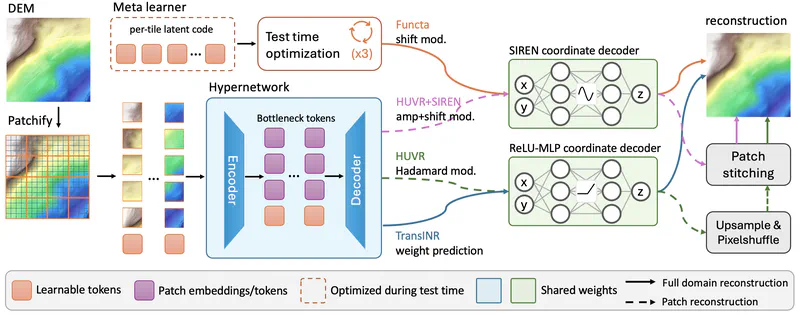
Rethinking Amortized Neural Representations for High-Resolution Terrain Elevation Data
A controlled benchmark of amortized neural representations on high-resolution (1 m/pixel) terrain elevation data, and HUVR+SIREN — a hypernetwork with a smooth, analytically differentiable decoder that attains the best height and derivative fidelity with no extra per-tile storage.
Nov 3, 2026
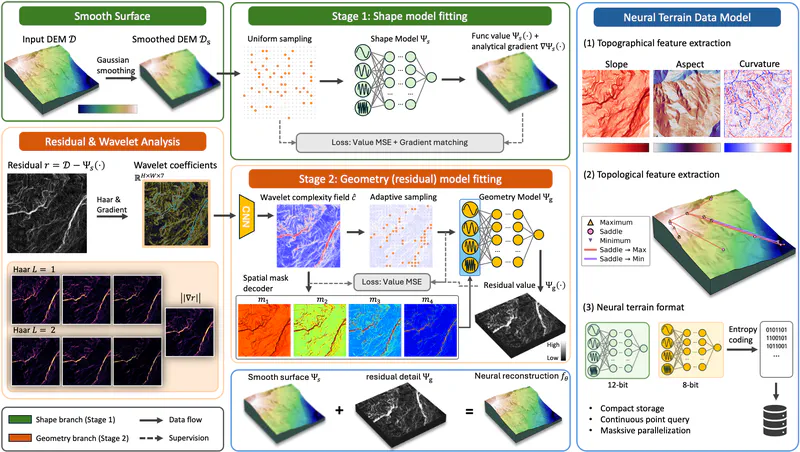
ImplicitTerrainV2: Wavelet-Guided Spatially Adaptive Neural Terrain Representation
A wavelet-guided, spatially adaptive implicit neural representation for digital elevation models. A wavelet complexity field localizes high-frequency capacity to complex terrain, and post-training compression reaches 1.23 bpp — 66.25 dB PSNR on Swiss terrain tiles, +5.70 dB over prior work with 3.2x fewer parameters.
Nov 3, 2026
A Topology-Guided GeoAI Agentic Framework for Urban Flood Screening
A topology-guided GeoAI agentic framework combining public geospatial data, deterministic terrain analysis, evidence-grounded LLM decisions, and human oversight for urban flood screening. Top-10 finalist at OASIS 2026.
Nov 3, 2026
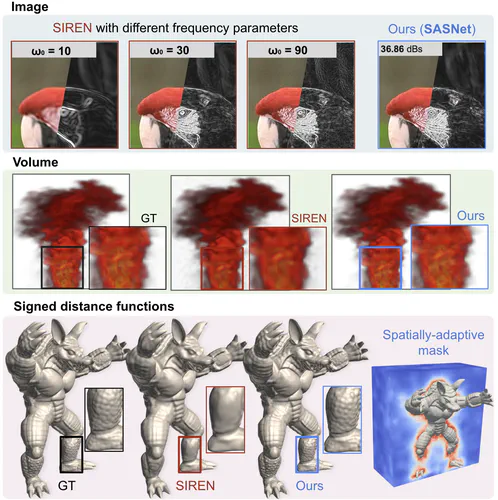
SASNet: Spatially-Adaptive Sinusoidal Networks for INRs
A spatially-adaptive sinusoidal network for implicit neural representations. A frozen frequency embedding fixes the frequency support while jointly learned spatial masks localize each neuron, giving sharper edges, less background noise, and faster convergence on images, volumes, and SDFs.
Jun 1, 2026
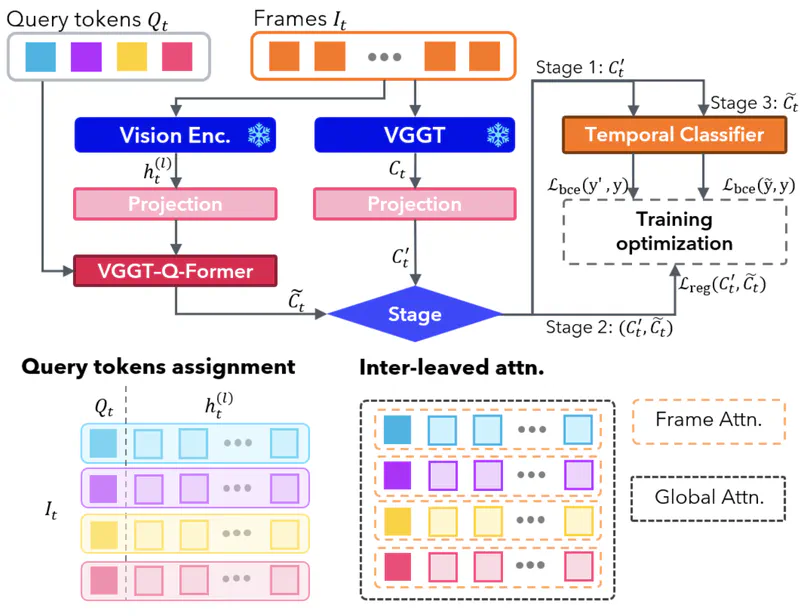
Geometry-Guided Camera Motion Understanding in VideoLLMs
Benchmarking, diagnosing, and fixing camera motion understanding in VideoLLMs. We release CameraMotionDataset and CameraMotionVQA, probe where camera cues are lost in the vision encoder, and inject geometry-derived motion primitives at inference — no fine-tuning required.
Mar 13, 2026
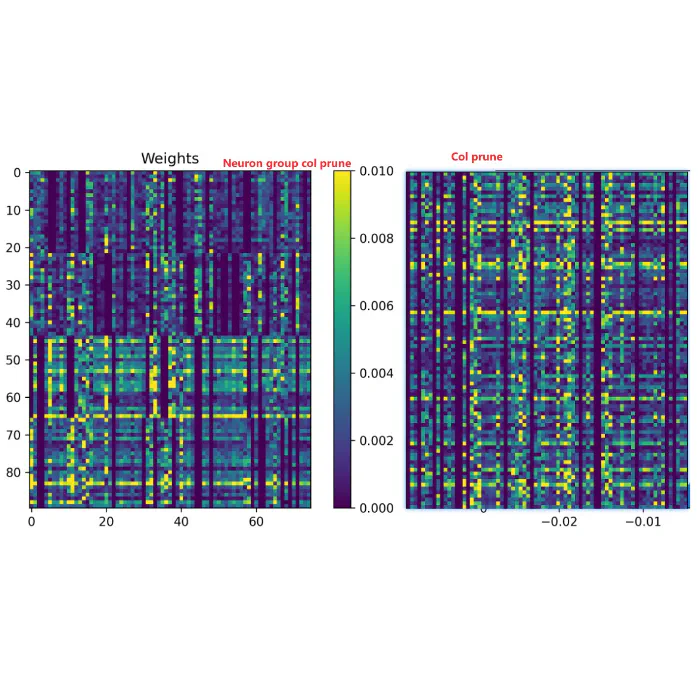
Structured Pruning in Implicit Neural Representations
Work in progress on structured pruning for implicit neural representations — removing whole sinusoidal neurons from a trained INR to shrink the model while preserving reconstruction quality.
Sep 15, 2024
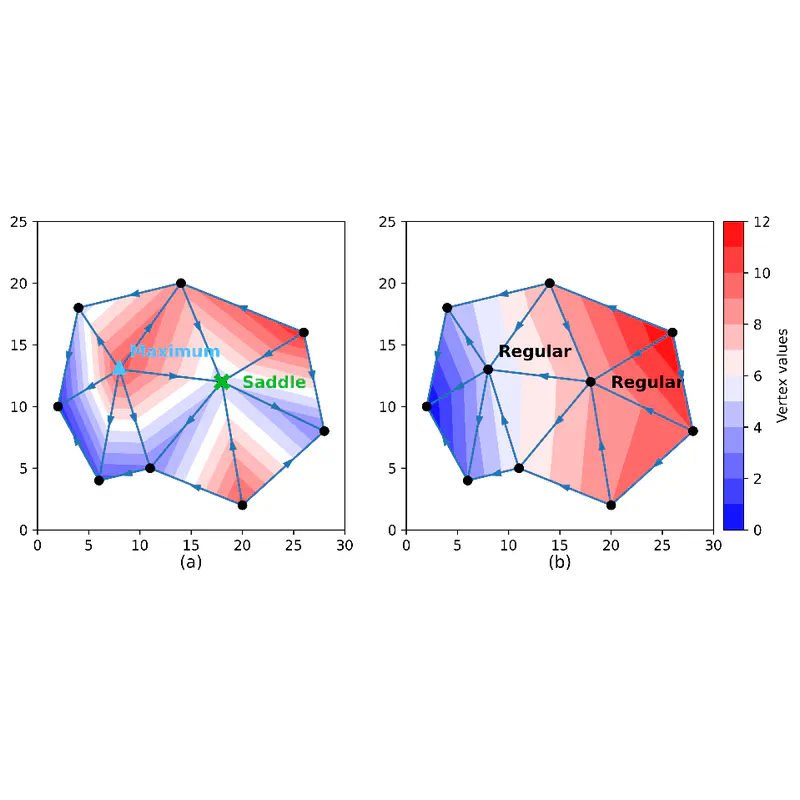
Critical Features Tracking on Triangulated Irregular Networks by a Scale-Space Method
Best Paper Runner-Up at ACM SIGSPATIAL 2024. A scale-space method that identifies and tracks topologically important terrain features directly on Triangulated Irregular Networks, handling irregular point distributions and boundaries that grid-based DEM methods cannot.
Sep 14, 2024
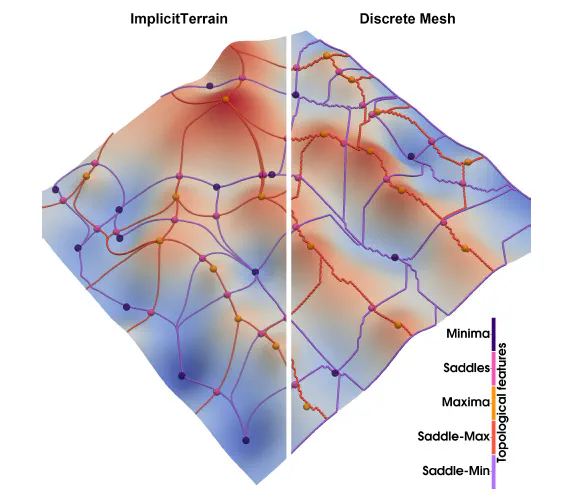
ImplicitTerrain: a Continuous Surface Model for Terrain Data Analysis
ImplicitTerrain models high-resolution digital terrain continuously and differentiably with an implicit neural representation, enabling accurate surface fitting and parallel topological feature extraction directly from the compact learned model.
Jun 18, 2024
Learning Discriminative Feature with CRF for Unsupervised Video Object Segmentation
An unsupervised video object segmentation method that learns discriminative appearance and motion features and refines them with a conditional random field (CRF). Published at ECCV 2020.
Jan 1, 2020